Wednesday, May 30, 2012
A Letter from the Canadian Society of Ecology and Evolution to Minister Ashfield and PM Harper
My former supervisor, Dr. Jeffrey Hutchings, current President for the Canadian Society of Ecology and Evolution (of which I am a member) sent the following letter to Keith Ashfield, and distributed copies to all members of the CSEE. I post the letter below so that my Canadian friends can see the concerns that leading Canadian scientists have about the state of science and our biological resources under the Harper government.

Wednesday, May 09, 2012
Natural Selection - Chapter 4 in the Origin of Species
So far in
our tour of the Origin we have seen that pre-Darwinian scientists defined
species as distinct entities created by God, and varieties as deviations from
the species-type, such deviations occurring due to natural means. Darwin, in part by observing the human-caused
production of domestic organisms argued that varieties
evolve within a species, and as they become more distinct they in turn become
new species. There is, therefore, nothing
directly divine about the production of species (although God could still be
operating behind the scenes, directing the evolution of species). In chapter three, Darwin argued that
organisms produce more offspring than can possibly survive. Through some mechanism unknown to Darwin,
these offspring differ from one another by a small degree; those individuals
that have beneficial variations will outcompete those that do not, and will be
more likely to survive and pass on their traits to their offspring. This is the foundation of natural selection.
Tuesday, May 01, 2012
Evolution and the Churches of Christ
It has been an interesting few months for my particular flavour of Christianity, the Restoration Movement (also known as the Stone-Campbell Movement). The Restoration Movement began in America (and is indeed more popular in America than in Canada) in the early 1800s as two separate movements, one led by Barton Stone and the other by the father and son team of Thomas and Alexander Campbell, both of whom sought to bring the church back to its New Testament roots (hence 'restoration'). It emerged within the context of the Second Great Awakening at Cane Ridge. Justice and equality were important virtues for Restoration Movement followers - the Campbells began their work in response to the exclusivity within their Presbyterian churches, in which the poor and outcast were not allowed to participate in communion. From this simple beginning the Restoration Movement churches - Churches of Christ (independent), Churches of Christ (a cappella) and the denominational Disciples of Christ - were founded. The independent and a cappella churches are considered to be non-denominational, their slogan being 'we are Christians only, but we are not the only Christians.'
Wednesday, April 18, 2012
#5: Creation Brings Glory to God

We are halfway through our top ten reasons for creation care, and this just in time for Earth Day this Sunday! Rather than go through the previous five points, let's jump right into this one:
5. Creation brings glory to God.
Thursday, April 12, 2012
#6. We are to seek restoration in all relationships

Sorry I've been off for a while, I took a week long challenge to stay away from all forms of electronic entertainment, which included this blog. But I'm back to carry on with our top ten reasons that every Christian should care for the environment. To recap:
10. The world is good.
9. God blessed his creation.
8. God cares for his creation.
7. God imposed restrictions on our use of the natural world.
Today we are looking at the concept of shalom, and how God asks us to seek restoration in all of our relationships.
Friday, March 23, 2012
#7: God Imposed Restrictions on Our Use of the Natural World
We're continuing on with our top ten reasons that every Christian should care for the environment. Specifically, these are scriptural reasons, that presume that the Bible has some form of authority over our lives. We have, to date, seen that in the Bible there is a theme about the value of creation. God declares his creation to be good; he blesses his creation; and he cares and provides for his creation. These three points alone should be sufficient to cause Christians to re-examine their perspective on ‘rule’ in Genesis 1:28. If God had given creation over to us to use and abuse as we see fit, then he would not be exercising his own rule over it, nor would he institute blessings that might not be in the best interest of our rule. Today we will explore this in more detail, by looking at Old Testament passages and seeing that God put moral restrictions on our rule over creation. It becomes increasingly obvious, the more we study, that ‘rule’ cannot mean ‘as you see fit.’
Monday, March 19, 2012
#8: God Cares For His Creation

Today we continue our countdown of the top 10 reasons every Christian should care for the environment.
10. The world is good.
9. God blessed His creation.
8. God cares for His creation.
Today’s point consists of three smaller points:
a) God brags about His creation
In Job 39 God asks Job a series of questions out of a whirlwind, with the intention of reminding Job of God’s might power. Many of these questions center around both wild and domestic animals. One gets the sense that God believes his power to be evident in creation, and that he is proud of the works of his hand. Read, for instance:
Thursday, March 08, 2012
Struggle for Existence - Chapter 3 in the Origin of Species
 |
| Locust swarms involve intense competition for resources |
At this point in our tour of Darwin’s Origin, Darwin has questioned the 19th-century view of species as distinct entities created by God, and varieties as deviations from the species-type. Instead, Darwin has presented compelling evidence, in large part through domestic organisms, that varieties and species are not different in kind, but only in degree. That is, varieties, when they become especially well-marked, are identified as species. A species evolves into different varieties; those varieties, in turn, may evolve into new species.
Darwin has also argued that there is a considerable amount of individual-level variation that exists in wild populations, and it is this variation that is the fuel for what he calls ‘natural selection’, a metaphorical phrase that he took from the phrase ‘artificial selection’. Artificial selection occurs when humans look at a population and choose the individuals that have the best features for breeding. Natural selection, although there is no conscious choice occurring, is the equivalent process that occurs in the wild. Survival of the fittest.
In chapter three, Darwin sets the scene for his next chapter on natural selection. Here he argues that waste and death is the hallmark of nature and is essential for speciation, rather than direct miraculous intervention from a beneficent God. Babies die, and they die in large quantities. This is an essential truth, if we wish to understand evolution.
Sunday, March 04, 2012
Top 10 Reasons Every Christian Should Care for the Environment - # 9: God blessed His creation
We continue our countdown of the top 10 reasons every Christian should be taking care of this planet, in preparation for Earth hour at 8:30 pm on March 31.
10. The world is good
9. God blessed His creation
We Christians have made a great deal of Genesis 1:28: ‘God blessed them and said to them, “Be fruitful and increase in number; fill the earth and subdue it. Rule over the fish in the sea and the birds in the sky and over every living creature that moves on the ground.”’
Tuesday, February 28, 2012
Top 10 Reasons Every Christian Should Care for the Environment - # 10: The World is Good

Saturday, March 31, at 8:30 pm is Earth hour, in which people around the planet will be unplugging the electric items in their house and turning their lights off to raise awareness for environmental care.
As an Albertan resident and a member of a fairly conservative branch of Christianity, I have encountered time and again over the last few weeks just how little many Christians think or care about the environment, and how little they think of people who do. Environmentalism is almost a curse word for many conservative Christians, as if earnestly seeking to restore the beauty of the planet is at best a waste of time and at worst an act of paganism. One particular Christian college recently conducted a survey about their effectiveness. One respondent was concerned that the college was becoming theologically liberal. In particular, this respondent was bothered by lectures on environmental care that were being taught in a social justice class. This boggles my mind. And so the next ten blog posts are not written for non-Christians or those who already care about the planet. From now until
Today we begin with number ten: The World is Good
Thursday, February 09, 2012
Dr. Daniel Dennett in Calgary Saturday!!! (revised)

Update: Due to mechanical failure, Dr. Dennett's plane did not arrive in Calgary on time. His talk has been rescheduled for Saturday Feb 11, 4:30 pm in ST140.
Exciting news - Daniel Dennett is the speaker for the University of Calgary's 27th annual Darwin Dinner, and I (along with a friend) get to pick him up from the airport tomorrow! For those of you who are in town, his lecture, entitled 'The Evolution of Reasons' will be held in Science Theatres 140 at 4:30 pm. If you can't make it, you can get a taste of Dr. Dennett at 7:20 am on CBC radio.
I've been reading Breaking the Spell, Dennett's most famous contribution to that seemingly ubiquitous genre of anti-religious treatises. I can say that it is likely the best that any of the big four (Dennett, Harris, Hitchens and Dawkins) have produced, and am finding it to be stimulating rather than infuriating (although brace yourself for a less-than-sensitive opening metaphor).
I'll let you know how the talk goes, along with the behind-the-scenes tour of the Royal Tyrrell Museum I will be taking with Dr. Dennett on Saturday (if everything goes as planned)!
Tuesday, January 24, 2012
Variation under Nature - Chapter 2 in the Origin of Species
 |
| The giraffe species is divided into several populations, each exhibiting a region-specific colouration pattern on the hide. These have become identifiers for dividing giraffes into distinct subspecies. |
In the first chapter of the Origin of Species, Darwin looked to domestic animals and concluded that the varieties of domestic breeds were created by man by selecting individuals with slight variants and accumulating these changes over numerous generations. He referred to this as artificial selection. In chapter two he begins to show how artificial selection can inform us of how species are formed, through the more powerful ‘natural’ selection.
Thursday, January 19, 2012
Variation under Domestication

This semester I am taking a course on Darwin’s first edition of On the Origin of Species. I thought that I would post chapter summaries of the Origin as I read it, to help keep the material straight in my mind and hopefully introduce you to one of the most important texts of the past 150 years. If you are a creationist, perhaps you will find less in this book to fear than you had thought; if you are a scientist, you might be surprised by how prescient Darwin was in many ways. If you are neither, you will still be impressed with the power of Darwin’s arguments. If you would like, you can follow along by reading the Origin with me – the first edition is free online at http://embryology.med.unsw.edu.au/pdf/Origin_of_Species.pdf.
I will be skipping over the opening quotes (read my thoughts on them here) and the introduction, and will dive right into the meat of the thing. This one's a long one...it should be shorter in the future!
Wednesday, January 18, 2012
I'm Back!
I’m back! I know it has been a long time since you saw me on this blog, but I am back and ready to roll with hopefully some more interesting articles regarding science and faith. A lot has happened since my last post in October. For one thing, I am now a Master of Science – I successfully defended my thesis on December 1 (which was the most terrifying and stressful day of my life), and submitted the corrected text on the 12th. It measured in at 152 pages in length, written over a gruelling seven weeks. But it is done!!! My lack of posting on this blog since then is simply because my mind was aching at the thought of putting any more words to paper. But I have now started my PhD, and need to get myself back into the game. So expect weekly posts at a minimum for the next while.
The other incredible news is that I am now engaged to my lovely girlfriend of the past 16 months. We are currently looking at wedding venues, but hope to be married in August of this year, so there will be another time of silence on this blog.
Surprisingly, the number of viewers to this blog did not decline dramatically when I stopped posting. There was a bit of a decline, but lots of people are finding me through Google. August and September I had around 800 hits each month, while October, November and December, in which I posted no articles, still received 600 hits per month. This is astronomically higher than I had ever hoped when I began this blog – so here’s to a new year, new postings, new visitors, and hopefully new insights! Thanks to everyone who reads this blog and has made it worth my time!
Monday, October 17, 2011
Fish Rescue!
Every year Trout Unlimited goes into closed irrigation canals across Alberta and pulls out the trapped fish who would otherwise freeze to death. Last year, in five canals, over 20 000 fish, both game fish and 'minnows' were rescued by Trout Unlimited volunteers. This past October 1 myself and some friends from three Calgary churches joined biologists from Trout Unlimited in identifying and releasing fish trapped in a High River irrigation canal back into the wild. Although the numbers have yet to be released, we handled well over 1000 fish. We saw quite a diversity, including brook chub, longnose dace, mountain suckers, white suckers, longnose suckers, trout-perch, slimy (?) sculpin, brook trout and rainbow trout. The morning was wet and miserable, but by lunch the sun was shining through. I wanted to thank all those who participated (particularly those who were afraid of fish but bravely handled them). It was, I think, an all-around positive experience. 'Rule over the fish of the sea...' (Genesis 1:28). While they might not have come from the sea, I think this group followed the principle of the matter. Some fish doomed to death were given a new lease on life.
Below are some photos from the rescue.
Friday, October 07, 2011
Tuesday Morning Comics #9
Hi folks! My Master's thesis is coming along, but it is a time-consuming and tiring process. I have until November 7 to submit, and then I defend on Dec 1! I am quite excited about the results, but I do wish I had another month to think about the ramifications of everything I've found. When I'm done this mad spree of writing, I will be back on here again regularly and will tell you all about what I do.
In the meantime, here's another comic! Because that is literally all the brain power I have left right now. I guess its maybe offensive. I think its kind of funny.
In the meantime, here's another comic! Because that is literally all the brain power I have left right now. I guess its maybe offensive. I think its kind of funny.

Tuesday, September 20, 2011
Tuesday Morning Comics #8
 Sorry folks, but I think things are going to be rather quiet on here until December. I am in thesis writing mode, and it has become unexpectedly stressful. I'm not going to have the luxury time I once had for quite a while. Please check in, as I will try to post comics or videos, but there will be no articles.
Today I don't actually have a comic for you, just an amazing work of art I stumbled upon somewhere online. The number of 'Jesus with dinosaur' images is staggering. I'm not quite sure the point, but it is usually in the context of Young Earth Creationists arguing that humans and dinosaurs once co-existed. Since kids love dinosaurs, there are many children's books put out by such organizations with truly inspired images.
Thursday, September 08, 2011
Seattle, Days Three through Five
The Conference of the American Fisheries Society is now officially over, and I am exhausted. It has been a long but intellectually stimulating time, and I am thankful that I came. I saw numerous good, some remarkably bad, and a few outstanding talks over the past few days, ranging from topics as diverse as plasticity in maximum critical temperatures for salmonids, to the negative role played by the media when it comes to reporting on overfishing (and where scientists go wrong when they create press releases); from mortality associated with catch-and-release bluefin fisheries, to how the Marine Stewardship Council's anonymous pre-assessment for MSC certification has changed the state of the fishing industry.
Tuesday, September 06, 2011
Seattle, Day Two
Hello folks, I just wanted to give a brief update on the conference so far, before I run down to the Seattle Aquarium for a social. Yesterday (Monday) was the first day of talks at the American Fisheries Society conference.
I figure most of you don't know what a science conference is like, so forgive me if I get into too much detail.
The day began dreadfully early. The plenary talks began at 8 am at the beautiful historical Paramount Theatre. It opened up, surprisingly, with a prayer in the language of one of the Native American tribes that fish salmon along the Washington coast. What was even more surprising was that the prayer was not an invocation to the Great Spirit, but was actually a Christian prayer ending with 'the name of your son Jesus, amen.' This was followed by a traditional Shaker song in a native tongue. It was certainly an intriguing and unexpected beginning to a scientific conference.
I figure most of you don't know what a science conference is like, so forgive me if I get into too much detail.
The day began dreadfully early. The plenary talks began at 8 am at the beautiful historical Paramount Theatre. It opened up, surprisingly, with a prayer in the language of one of the Native American tribes that fish salmon along the Washington coast. What was even more surprising was that the prayer was not an invocation to the Great Spirit, but was actually a Christian prayer ending with 'the name of your son Jesus, amen.' This was followed by a traditional Shaker song in a native tongue. It was certainly an intriguing and unexpected beginning to a scientific conference.
Monday, September 05, 2011
Seattle, Day One
Sunday
Well, I have arrived in Seattle safe and sound for the 141st annual meeting of the American Fisheries Society (AFS). If you can believe it, fisheries scientists having met every single year since just after the end of the Civil War, and today I have become a participant in that long tradition.
This is by far the largest conference I have ever attended, with over 4600 people registered, 2000 of which are giving talks and another 500 of which presented posters this (Monday) evening.
But I am getting ahead of myself.
Well, I have arrived in Seattle safe and sound for the 141st annual meeting of the American Fisheries Society (AFS). If you can believe it, fisheries scientists having met every single year since just after the end of the Civil War, and today I have become a participant in that long tradition.
This is by far the largest conference I have ever attended, with over 4600 people registered, 2000 of which are giving talks and another 500 of which presented posters this (Monday) evening.
But I am getting ahead of myself.
Saturday, September 03, 2011
Conference Time!
Sorry for no real post today. I'm getting ready for a conference in Seattle (American Fisheries Society, you can read about it here). I will be one of 2000 people giving actual talks during the conference, plus who knows how many poster presentations. It should be a fun conference, I will try to keep you updated as it goes.
My talk is not until Wednesday, so I will have plenty of time to be nervous!
My talk is not until Wednesday, so I will have plenty of time to be nervous!
Tuesday, August 30, 2011
Tuesday Morning Comics #7

Today's comic comes from our Young Earth Creationist friends over at Answers in Genesis (AiG). Here we see, pictorially represented, a standard argument used by AiG and Creation Ministries International (CMI) (indeed, I heard Richard Fangrad use this argument himself). Evolution and Creation, they argue, are both interpretations of the same evidence. The Christian looks at the facts of the natural world, such as fossils and genetic similarities between organisms and mass extinctions and sedimentary rocks, and interprets those objective points of data through the lens of scripture. This provides them with an overwhelming belief in the majesty of a creator who shaped the world according to a literal reading of Genesis. The evolutionist looks at those same facts and interprets them through the lens of The Origin of Species and other such evolutionary texts, and comes to an overwhelming belief in the truth of blind, random evolution. The only difference between the two viewpoints is their explanatory framework.
Friday, August 26, 2011
Foolish Wisdom - 1 Corinthians and a Defence of Higher Education
In 1 Corinthians 3:18-20, Paul has some seemingly searing words for academics:
‘Do not deceive yourselves. If any of you think you are wise by the standards of this age, you should become “fools” so that you may become wise. For the wisdom of this world is foolishness in God’s sight. As it is written: “He catches the wise in their craftiness”; and again, “The Lord knows that the thoughts of the wise are futile.”’
Again, in 1 Corinthians 1:20, Paul writes, ‘Where is the wise person? Where is the teacher of the law? Where is the philosopher of this age? Has not God made foolish the wisdom of the world?’
Tuesday, August 23, 2011
Genetics and the Origin of Species
 |
| The mule is a famous example of a sterile hybrid. Photo circa 1937 |
We are officially almost finished our summer-long read through Dobzhansky’s evolutionary classic, Genetics and the Origin of Species. We have spent an awful lot of time talking about genetics – about mutations, and how their value is context-dependent; about chromosomes, and how breakdowns during cell replication and gamete production can lead to large-scale changes; about natural selection, and how it affects gene frequencies; but now it is time to actually roll up our sleeves and delve into the ‘origin of species’ part of Dobzhansky’s book title. Last week we explored polyploidy, a form of instant speciation that is solely due to reproductive incompatibilities brought about by chromosomal mismatch.
In other words, last week we saw that a simple genetic cause (chromosomal duplication) led to instant speciation, simply because the polyploid and its parental form could not successfully reproduce (or, more precisely, their offspring could not reproduce); that is, the polyploidy event caused a reproductive barrier to form between the parent and its polyploid offspring. They were reproductively isolated.
Tuesday, August 16, 2011
Tuesday Morning Comics #6
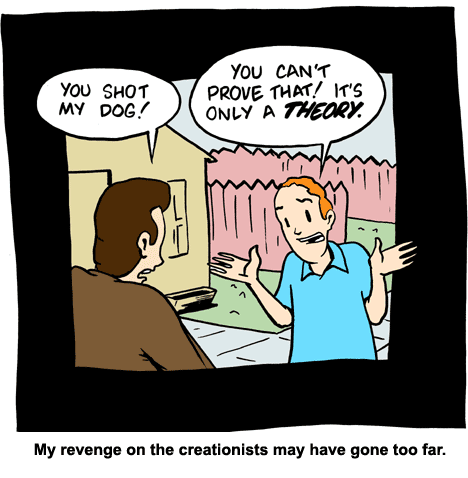
Here's another bit of irreverent humour from Saturday Morning Breakfast Cereal, poking fun at the Creationist misuse of 'theory'. When biologists speak of evolution, they can speak of evolution as a 'fact', by which they are referring to things like experimental evolution in which change in a species is documented and not inferred, and they can speak of evolution as a 'theory', by which they mean that evolution is an explanatory framework which includes and explains, under a unifying whole, a disparate group of facts that had heretofore been considered separate. Thus the Darwinian theory of evolution explains, among other things, the genetic similarities between all living things; adaptation; biogeography; palaeontology; morphological similarities; homologies; and a whole host of other things. When Creationists say that evolution is 'just a theory', they mean something very different. They quote the biologists who use the word theory, but they do not use it in the elevated sense of the biologist; instead they use it in its colloquial sense, as 'sheer speculation' or 'unproven'. The above comic captures fairly well (and hilariously) the frustration that biologists feel over the consistent misuse of this important word.
Thursday, August 11, 2011
Even You Can Create a New Species - The Curious Case of Polyploidy
There are currently 1.7 million named species of plants, animals and algae on this planet. This does not include the vast array of bacteria and other such single-celled creatures. And those are only the ones we know about – based on rates of discovery, the National Science Foundation estimates that we have only described 10% of the world’s true diversity. Most of these organisms will likely be small or marine, but not all; twenty-five species of primates have been discovered since 2000 alone. And then this diversity really only scrapes the surface of the total diversity that has ever existed, with a mind-boggling number of plant and animal species known only from the fossil record.
Theodosius Dobzhansky, in Genetics and the Origin of Species (1937), presents, in chapters 7-9, an introductory treatment on the topic of speciation. He brings genetics and natural selection and various observations together to provide a compelling account of how new species are formed. This would be the groundwork used by Enrst Mayr, who would develop the modern Biological Species Concept.
Tuesday, August 09, 2011
Communion and a Call for Social Justice
 I have, for most of my life, gone to a church that practices weekly Communion (what you may also know as the Lord’s Supper, or Eucharist, depending on your background). Unlike Catholic traditions, my evangelical church would pass out tiny little cups containing grape juice, and would have tiny little portions of unleavened bread. We would, as a body, take these little tokens/symbols (for us, not Sacraments) and ‘partake’ of them. That was always the phrase. ‘Partake’. It was never ‘eat’ or ‘digest’ or, heaven forbid, ‘masticate’. We were much more respectful than that.
Saturday, August 06, 2011
Natural Selection
We continue with our (seemingly unending) walkthrough of Dobzhansky’s evolutionary classic, Genetics and the Origin of Species. Today we will finish his chapter on Selection; the rest of the book will be a cakewalk in comparison.
Natural selection was not unique to Darwin, having been recorded by numerous others, including the watchmaker-hypothesis’ William Paley. But for these pre-Darwinian writers (with two minor exceptions, noted in the opening of the sixth edition of the Origin of Species), natural selection was simply a way of preserving the created species. Forces would try to alter the species into less-adapted products; natural selection would winnow out those mutant forms, allowing the species to remain relatively pure. Selection, then, was like a hangsman, killing off what nature abhorred. Darwin’s major insight was to raise the status of natural selection from preserver and destroyer to the primary creative force in nature. (I am indebted to Stephen Jay Gould’s book The Structure of Evolutionary Theory for much of this discussion).
Tuesday, August 02, 2011
Tuesday Morning Comics #5

Today's comic was clearly inspired by the teaching of Creationism in the school system. Unfortunately, it is more insulting than inspired. The school board in question is represented by a large-bodied cartoonish imbecile who is apparently not as 'evolved' as modern humans. This comic would lead you to believe that the school board has less intelligence than a Neanderthal! I am somewhat torn by this comic - I understand why people would find it funny, but this sort of name-calling is less than helpful, and is a real mischaracterization of the people who make up the Creationist movement. Contrary to the public perception, Creationists are not idiots. Philip Johnson, for example, is a leading Creationist and Intelligent Design proponent, yet teaches law at the University of California - Berkeley. Last I checked, UCB does not hire slobbering morons. The people that I have met who are strong Creationists may be stubborn to the point of annoyance, but they are intelligent people with, often, intelligent critiques. It is just that their body of knowledge tends to be in a different direction than the body of knowledge that evolutionists have.
Friday, July 29, 2011
Natural Selection and Population Growth
 |
| The yearly population explosion of crabs on Christmas Island was possibly due to the extinction of a native predator; the recent introduction of the yellow crazy ant has started bringing this population back down |
By this point in our walkthrough of Dobzhansky’s biological classic, Genetics and the Origin of Species, we have seen how much raw phenotypic variation exists in the wild, and how this variation is generated by several different mechanisms, including mutations. And we have discovered that some of this phenotypic variation, namely, genetic variation, is passed from parents to offspring. Without heritable genetic variation, there can be no evolution. But what drives evolution? As we saw last week, evolution can be driven by mutation pressures and genetic drift. But usually when we think of evolution, we are thinking of evolution by natural selection. Dobzhansky devotes chapter six to this important topic.
Subscribe to:
Posts (Atom)