Hello everyone and happy New Year. Now that I have finished teaching my course on Science and the Christian Faith at Alberta Bible College, I actually have time to write on this blog again! My New Years' resolution is to post one blog a week (I began this resolution today, so ignore the fact that I missed the first week). I certainly have a wealth of things to share from the last semester! Today though I would like to discuss what I consider to be a fairly compelling piece of evidence for the evolution of humans from nonhuman primates, and it comes from a strange source: vitamin C.
Showing posts with label Evolution. Show all posts
Showing posts with label Evolution. Show all posts
Friday, January 11, 2013

Tuesday, May 01, 2012
Evolution and the Churches of Christ
It has been an interesting few months for my particular flavour of Christianity, the Restoration Movement (also known as the Stone-Campbell Movement). The Restoration Movement began in America (and is indeed more popular in America than in Canada) in the early 1800s as two separate movements, one led by Barton Stone and the other by the father and son team of Thomas and Alexander Campbell, both of whom sought to bring the church back to its New Testament roots (hence 'restoration'). It emerged within the context of the Second Great Awakening at Cane Ridge. Justice and equality were important virtues for Restoration Movement followers - the Campbells began their work in response to the exclusivity within their Presbyterian churches, in which the poor and outcast were not allowed to participate in communion. From this simple beginning the Restoration Movement churches - Churches of Christ (independent), Churches of Christ (a cappella) and the denominational Disciples of Christ - were founded. The independent and a cappella churches are considered to be non-denominational, their slogan being 'we are Christians only, but we are not the only Christians.'
Tuesday, August 23, 2011
Genetics and the Origin of Species
 |
| The mule is a famous example of a sterile hybrid. Photo circa 1937 |
We are officially almost finished our summer-long read through Dobzhansky’s evolutionary classic, Genetics and the Origin of Species. We have spent an awful lot of time talking about genetics – about mutations, and how their value is context-dependent; about chromosomes, and how breakdowns during cell replication and gamete production can lead to large-scale changes; about natural selection, and how it affects gene frequencies; but now it is time to actually roll up our sleeves and delve into the ‘origin of species’ part of Dobzhansky’s book title. Last week we explored polyploidy, a form of instant speciation that is solely due to reproductive incompatibilities brought about by chromosomal mismatch.
In other words, last week we saw that a simple genetic cause (chromosomal duplication) led to instant speciation, simply because the polyploid and its parental form could not successfully reproduce (or, more precisely, their offspring could not reproduce); that is, the polyploidy event caused a reproductive barrier to form between the parent and its polyploid offspring. They were reproductively isolated.
Tuesday, August 16, 2011
Tuesday Morning Comics #6
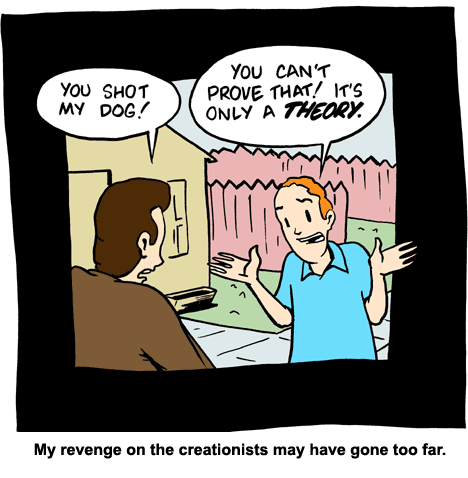
Here's another bit of irreverent humour from Saturday Morning Breakfast Cereal, poking fun at the Creationist misuse of 'theory'. When biologists speak of evolution, they can speak of evolution as a 'fact', by which they are referring to things like experimental evolution in which change in a species is documented and not inferred, and they can speak of evolution as a 'theory', by which they mean that evolution is an explanatory framework which includes and explains, under a unifying whole, a disparate group of facts that had heretofore been considered separate. Thus the Darwinian theory of evolution explains, among other things, the genetic similarities between all living things; adaptation; biogeography; palaeontology; morphological similarities; homologies; and a whole host of other things. When Creationists say that evolution is 'just a theory', they mean something very different. They quote the biologists who use the word theory, but they do not use it in the elevated sense of the biologist; instead they use it in its colloquial sense, as 'sheer speculation' or 'unproven'. The above comic captures fairly well (and hilariously) the frustration that biologists feel over the consistent misuse of this important word.
Thursday, August 11, 2011
Even You Can Create a New Species - The Curious Case of Polyploidy
There are currently 1.7 million named species of plants, animals and algae on this planet. This does not include the vast array of bacteria and other such single-celled creatures. And those are only the ones we know about – based on rates of discovery, the National Science Foundation estimates that we have only described 10% of the world’s true diversity. Most of these organisms will likely be small or marine, but not all; twenty-five species of primates have been discovered since 2000 alone. And then this diversity really only scrapes the surface of the total diversity that has ever existed, with a mind-boggling number of plant and animal species known only from the fossil record.
Theodosius Dobzhansky, in Genetics and the Origin of Species (1937), presents, in chapters 7-9, an introductory treatment on the topic of speciation. He brings genetics and natural selection and various observations together to provide a compelling account of how new species are formed. This would be the groundwork used by Enrst Mayr, who would develop the modern Biological Species Concept.
Saturday, August 06, 2011
Natural Selection
We continue with our (seemingly unending) walkthrough of Dobzhansky’s evolutionary classic, Genetics and the Origin of Species. Today we will finish his chapter on Selection; the rest of the book will be a cakewalk in comparison.
Natural selection was not unique to Darwin, having been recorded by numerous others, including the watchmaker-hypothesis’ William Paley. But for these pre-Darwinian writers (with two minor exceptions, noted in the opening of the sixth edition of the Origin of Species), natural selection was simply a way of preserving the created species. Forces would try to alter the species into less-adapted products; natural selection would winnow out those mutant forms, allowing the species to remain relatively pure. Selection, then, was like a hangsman, killing off what nature abhorred. Darwin’s major insight was to raise the status of natural selection from preserver and destroyer to the primary creative force in nature. (I am indebted to Stephen Jay Gould’s book The Structure of Evolutionary Theory for much of this discussion).
Tuesday, August 02, 2011
Tuesday Morning Comics #5

Today's comic was clearly inspired by the teaching of Creationism in the school system. Unfortunately, it is more insulting than inspired. The school board in question is represented by a large-bodied cartoonish imbecile who is apparently not as 'evolved' as modern humans. This comic would lead you to believe that the school board has less intelligence than a Neanderthal! I am somewhat torn by this comic - I understand why people would find it funny, but this sort of name-calling is less than helpful, and is a real mischaracterization of the people who make up the Creationist movement. Contrary to the public perception, Creationists are not idiots. Philip Johnson, for example, is a leading Creationist and Intelligent Design proponent, yet teaches law at the University of California - Berkeley. Last I checked, UCB does not hire slobbering morons. The people that I have met who are strong Creationists may be stubborn to the point of annoyance, but they are intelligent people with, often, intelligent critiques. It is just that their body of knowledge tends to be in a different direction than the body of knowledge that evolutionists have.
Friday, July 29, 2011
Natural Selection and Population Growth
 |
| The yearly population explosion of crabs on Christmas Island was possibly due to the extinction of a native predator; the recent introduction of the yellow crazy ant has started bringing this population back down |
By this point in our walkthrough of Dobzhansky’s biological classic, Genetics and the Origin of Species, we have seen how much raw phenotypic variation exists in the wild, and how this variation is generated by several different mechanisms, including mutations. And we have discovered that some of this phenotypic variation, namely, genetic variation, is passed from parents to offspring. Without heritable genetic variation, there can be no evolution. But what drives evolution? As we saw last week, evolution can be driven by mutation pressures and genetic drift. But usually when we think of evolution, we are thinking of evolution by natural selection. Dobzhansky devotes chapter six to this important topic.
Monday, July 18, 2011
Evolution is Math is Fun!
Evolution is ultimately mathematical. This is in part why I have taken so long to continue with Dobzhansky’s book, Genetics and the Origin of Species – we are now getting to the math. But the math cannot be ignored – in the early 1900s, some brilliant mathematicians developed formulae that predicted what biologists would spend the next seventy-plus years confirming experimentally. Darwinian evolution is a case in which number (largely) preceded biology.
Wednesday, July 06, 2011
Tuesday Morning Comics #2

Today's comic is from the Young Earth organization Answers in Genesis. This comic shows that Young Earth Creationists have a real concern for how Christians in general treat scripture. Those that believe in an old earth and/or the theory of evolution do not turn to Genesis to find out how God created the word; they treat Genesis in a non-literal manner, whether as allegory or myth or poetry. YEC are unsettled by this. Genesis, to them, is the 'book of beginnings', a recorded history of the beginning of God's covenant with His people and the beginning of the world itself. And this account of beginnings is a literal historical narrative. Those outside of the Christian faith may find this comic illuminating because it reveals a divide in Christianity between those who treat Genesis' opening chapters 'literally' (although even the literalists tend to allegoricalize when convenient) versus those who do not. Christianity is not a monolithic religion with each Christian believing the same thing. There is an incredible amount of diversity, a diversity which Answers in Genesis finds disturbing.
This comic also questions what Christians take to be authoritative. Is the only authority the Book of God's Word, or can we also turn to the Book of God's Works? Is creation as authoritative as scripture? Can a Christian, in good conscience, turn to the books of science to understand beginnings rather than the 'book of beginnings'? For YEC, the answer is clearly no; for other Christians, the answer is not so clear.
Yes, I realize today is actually Wednesday, but I've been at camp in PEI all week with a bunch of grade 2 and 3 students, and I did not come to this realization until just now. Deal with it.
Tuesday, June 28, 2011
Tuesday Morning Comics
Hi all! I've been spending a lot of time on here writing about science instead of science and religion (although I would argue that to discuss science and religion, religious people need to understand science, and scientists need to understand religion, which is what motivates these posts), so as I prepare to leave Quebec I wanted to share a science/religion comic with you. I find these things all over the internet, and I am amassing a collection of them. I'll post one from time to time.
Sunday, June 26, 2011
Variation
 |
Humans come in different shapes, sizes, colours, temperaments, propensities to disease and the like. Although the human population continues to increase, we seem to never run out of variations on the human ‘type’. All of the dog breeds of the world ultimately descend from the same wolf ancestor. The bulldog, the terrier, the great Dane, the German shepherd, were all produced when humans took existing varieties and made some choice selections. The same goes for our agricultural products: kale, cabbage, broccoli and cauliflower all descend from the same wild cabbage species. The fruit fly Drosophila pseudoobscura, according to Dobzhansky, has seven different types of Y chromosomes; there are strains of wheat with 7, 14 or 21 chromosomes.
Without variation, there can be no evolution. Dobzhansky spends the first four chapters of his book driving this point home, because it is that essential. If variation was not continually being produced, there would be no differences between individuals; without differences between individuals, there would be no selection; and without selection, there would be no adaptation.
Thursday, June 23, 2011
The Joy of Chromosomes (Part 3)
Last week we talked a bit about chromosomes, the process of sperm/egg/pollen formation, and how missteps during meiosis can lead to chromosomal mutations in terms of numbers of chromosomes. We defined haploidy and polyploidy as the loss or gain of an entire set of chromosomes, and monosomy and polysomy as the loss or gain of a single chromosome. We also saw how species and races contain variability, not just in the content of their DNA, but also in the number of chromosomes that they have. Humans, for instance, have one less chromosome than the other great apes; a single species of Iranian climbing weed has populations with vastly different numbers of chromosomes.
Today I’d like to continue following the layout of Dobzhansky’s book, Genetics and the Origin of Species, by continuing to categorize chromosomal mutations according to changes in their structure. Structural mutations do not affect the number of chromosomes within an organism, but rather alter the layout of genes within a chromosome. Structural mutations can be classified as follows:
Thursday, June 16, 2011
The Joy of Chromosomes (Part 2)
Chromosomes are the carriers of genes. Each chromosome acts as an individual, faithfully passing its structure on to its offspring each time a cell divides. But ‘faithfulness’ has its limits – occasionally a ‘mutant’ chromosome is produced that will then be replicated. The number of chromosomes within a cell can also be faithfully replicated down the generations, but occasionally they too can change.
When we talk about chromosomal mutations, then, we need to differentiate between changes in chromosome number and structure. Today, we will talk about number.
Tuesday, June 14, 2011
The Joy of Chromosomes (Part 1)
So, you have found yourself transported in time to the 1930s, and you have a strong desire to study mutations? But those uncivilized brutes have yet to develop methods for examining changes in DNA? Never fear! You can do the second-best thing, and rediscover everyone’s favourite pastime: karyotyping!
Tuesday, June 07, 2011
All Species Are the Products of Mutations
Summary so far
To recap our story: evolutionary biology’s ultimate quest is to explain the diversity and discontinuity we see in the natural world. A whale and a mouse are two very different things; they do not insensibly blend into one another. Yet despite their discontinuity, they also have very similar body structures. What accounts for this? And why in less extreme cases is this discontinuity at times fuzzy, such that we have difficulty telling if two different populations are different species, or merely varieties of the same species?
Saturday, June 04, 2011
Mutations: The Good, the Bad, and the Neutral (Part 5)
Lesson 5: A single mutation cannot create a new species
There was some debate during Dobzhansky’s time about whether new species could be formed through the birth of rare ‘monsters’. Such monsters would be the product of a mutation, and would be effectively shut off from the rest of the population, forming their own species. This theory was called saltationism. Saltationists argued that a single mutation can have a very large effect. A mutation somehow produces fundamental changes to the species, such that a new species is formed.
Friday, June 03, 2011
Mutations: The Good, the Bad, and the Neutral (Part 4)
We have so far learned from Dobzhansky that:
1. Mutations are common in nature and are the source of all diversity
2. Mutations can be really bad, to the point of being lethal, but there is a gradient from bad to good; bad mutations can hide as recessives within a population
3. Environmental change (or a change in the genetic background) can turn a ‘bad’ mutation good, and a ‘good’ mutation bad. Mutational value is contextual.
Lesson 4 – A single mutation can have a multitude of effects
Thursday, June 02, 2011
Mutations: The Good, the Bad, and the Neutral (Part 3)
Lesson 3 – The value of a mutation (good, bad, or neutral) changes with the environment. A mutation that appears to be bad in one context, might be good in another.
So far we have seen that mutations are common enough in nature, that bad mutations can hide as recessives within a population (contributing to the population’s overall genetic diversity), and that mutations can have anywhere from hugely negative effects (ie lethal mutations) to almost negligible effects.
What Dobzhansky has not yet shown is that mutations can be beneficial to the organism.
Wednesday, June 01, 2011
Mutations: The Good, the Bad, and the Neutral (Part 2)
Lesson 2: ‘Bad’ is a relative term. Some mutations are worse than others, and even really bad mutations can hide in a population.
As we saw yesterday, mutations occur frequently in nature. Inheritance of parental traits is conservative, in that it is usually quite faithful; but if it is completely faithful, there can never be variation in a trait. Mutations counter this ‘copy fidelity’, acting as an opposing ‘force’ that produces variation. Dobzhansky inferred from this that all of the heritable variation that we see in nature is due to mutations that have occurred either recently or in the remote past.
Subscribe to:
Posts (Atom)