Wednesday, January 18, 2012

I'm Back!

I’m back!  I know it has been a long time since you saw me on this blog, but I am back and ready to roll with hopefully some more interesting articles regarding science and faith.  A lot has happened since my last post in October.  For one thing, I am now a Master of Science – I successfully defended my thesis on December 1 (which was the most terrifying and stressful day of my life), and submitted the corrected text on the 12th.  It measured in at 152 pages in length, written over a gruelling seven weeks.  But it is done!!!  My lack of posting on this blog since then is simply because my mind was aching at the thought of putting any more words to paper.  But I have now started my PhD, and need to get myself back into the game.  So expect weekly posts at a minimum for the next while.

The other incredible news is that I am now engaged to my lovely girlfriend of the past 16 months.  We are currently looking at wedding venues, but hope to be married in August of this year, so there will be another time of silence on this blog.

Surprisingly, the number of viewers to this blog did not decline dramatically when I stopped posting.  There was a bit of a decline, but lots of people are finding me through Google.  August and September I had around 800 hits each month, while October, November and December, in which I posted no articles, still received 600 hits per month.  This is astronomically higher than I had ever hoped when I began this blog – so here’s to a new year, new postings, new visitors, and hopefully new insights!  Thanks to everyone who reads this blog and has made it worth my time!

Monday, October 17, 2011

Fish Rescue!

Every year Trout Unlimited goes into closed irrigation canals across Alberta and pulls out the trapped fish who would otherwise freeze to death.  Last year, in five canals, over 20 000 fish, both game fish and 'minnows' were rescued by Trout Unlimited volunteers.  This past October 1 myself and some friends from three Calgary churches joined biologists from Trout Unlimited in identifying and releasing fish trapped in a High River irrigation canal back into the wild.  Although the numbers have yet to be released, we handled well over 1000 fish.  We saw quite a diversity, including brook chub, longnose dace, mountain suckers, white suckers, longnose suckers, trout-perch, slimy (?) sculpin, brook trout and rainbow trout.  The morning was wet and miserable, but by lunch the sun was shining through.  I wanted to thank all those who participated (particularly those who were afraid of fish but bravely handled them).  It was, I think, an all-around positive experience.  'Rule over the fish of the sea...' (Genesis 1:28).  While they might not have come from the sea, I think this group followed the principle of the matter.  Some fish doomed to death were given a new lease on life.

Below are some photos from the rescue. 

Friday, October 07, 2011

Tuesday Morning Comics #9

Hi folks!  My Master's thesis is coming along, but it is a time-consuming and tiring process.  I have until November 7 to submit, and then I defend on Dec 1!  I am quite excited about the results, but I do wish I had another month to think about the ramifications of everything I've found.  When I'm done this mad spree of writing, I will be back on here again regularly and will tell you all about what I do.

In the meantime, here's another comic!  Because that is literally all the brain power I have left right now.  I guess its maybe offensive.  I think its kind of funny.


If only it were that easy.  Thanks once again, Saturday Morning Breakfast Cereal!

Tuesday, September 20, 2011

Tuesday Morning Comics #8

Sorry folks, but I think things are going to be rather quiet on here until December.  I am in thesis writing mode, and it has become unexpectedly stressful.  I'm not going to have the luxury time I once had for quite a while.  Please check in, as I will try to post comics or videos, but there will be no articles.

Today I don't actually have a comic for you, just an amazing work of art I stumbled upon somewhere online.  The number of 'Jesus with dinosaur' images is staggering.  I'm not quite sure the point, but it is usually in the context of Young Earth Creationists arguing that humans and dinosaurs once co-existed.  Since kids love dinosaurs, there are many children's books put out by such organizations with truly inspired images.

Thursday, September 08, 2011

Seattle, Days Three through Five

The Conference of the American Fisheries Society is now officially over, and I am exhausted.  It has been a long but intellectually stimulating time, and I am thankful that I came.  I saw numerous good, some remarkably bad, and a few outstanding talks over the past few days, ranging from topics as diverse as plasticity in maximum critical temperatures for salmonids, to the negative role played by the media when it comes to reporting on overfishing (and where scientists go wrong when they create press releases); from mortality associated with catch-and-release bluefin fisheries, to how the Marine Stewardship Council's anonymous pre-assessment  for MSC certification has changed the state of the fishing industry.

Tuesday, September 06, 2011

Seattle, Day Two

Hello folks, I just wanted to give a brief update on the conference so far, before I run down to the Seattle Aquarium for a social.  Yesterday (Monday) was the first day of talks at the American Fisheries Society conference.

I figure most of you don't know what a science conference is like, so forgive me if I get into too much detail.

The day began dreadfully early.  The plenary talks began at 8 am at the beautiful historical Paramount Theatre.  It opened up, surprisingly, with a prayer in the language of one of the Native American tribes that fish salmon along the Washington coast.  What was even more surprising was that the prayer was not an invocation to the Great Spirit, but was actually a Christian prayer ending with 'the name of your son Jesus, amen.'  This was followed by a traditional Shaker song in a native tongue.  It was certainly an intriguing and unexpected beginning to a scientific conference.

Monday, September 05, 2011

Seattle, Day One

Sunday

Well, I have arrived in Seattle safe and sound for the 141st annual meeting of the American Fisheries Society (AFS).  If you can believe it, fisheries scientists having met every single year since just after the end of the Civil War, and today I have become a participant in that long tradition.

This is by far the largest conference I have ever attended, with over 4600 people registered, 2000 of which are giving talks and another 500 of which presented posters this (Monday) evening.

But I am getting ahead of myself.

Saturday, September 03, 2011

Conference Time!

Sorry for no real post today.  I'm getting ready for a conference in Seattle (American Fisheries Society, you can read about it here).  I will be one of 2000 people giving actual talks during the conference, plus who knows how many poster presentations.  It should be a fun conference, I will try to keep you updated as it goes.

My talk is not until Wednesday, so I will have plenty of time to be nervous!

Tuesday, August 30, 2011

Tuesday Morning Comics #7


Today's comic comes from our Young Earth Creationist friends over at Answers in Genesis (AiG).  Here we see, pictorially represented, a standard argument used by AiG and Creation Ministries International (CMI) (indeed, I heard Richard Fangrad use this argument himself).  Evolution and Creation, they argue, are both interpretations of the same evidence.  The Christian looks at the facts of the natural world, such as fossils and genetic similarities between organisms and mass extinctions and sedimentary rocks, and interprets those objective points of data through the lens of scripture.  This provides them with an overwhelming belief in the majesty of a creator who shaped the world according to a literal reading of Genesis.  The evolutionist looks at those same facts and interprets them through the lens of The Origin of Species and other such evolutionary texts, and comes to an overwhelming belief in the truth of blind, random evolution.  The only difference between the two viewpoints is their explanatory framework.

Friday, August 26, 2011

Foolish Wisdom - 1 Corinthians and a Defence of Higher Education

In 1 Corinthians 3:18-20, Paul has some seemingly searing words for academics:

‘Do not deceive yourselves. If any of you think you are wise by the standards of this age, you should become “fools” so that you may become wise.  For the wisdom of this world is foolishness in God’s sight. As it is written: “He catches the wise in their craftiness”; and again, “The Lord knows that the thoughts of the wise are futile.”’

Again, in 1 Corinthians 1:20, Paul writes, ‘Where is the wise person? Where is the teacher of the law? Where is the philosopher of this age? Has not God made foolish the wisdom of the world?’

Tuesday, August 23, 2011

Genetics and the Origin of Species


The mule is a famous example of a sterile hybrid.  Photo circa 1937

We are officially almost finished our summer-long read through Dobzhansky’s evolutionary classic, Genetics and the Origin of Species.  We have spent an awful lot of time talking about genetics – about mutations, and how their value is context-dependent; about chromosomes, and how breakdowns during cell replication and gamete production can lead to large-scale changes; about natural selection, and how it affects gene frequencies; but now it is time to actually roll up our sleeves and delve into the ‘origin of species’ part of Dobzhansky’s book title.  Last week we explored polyploidy, a form of instant speciation that is solely due to reproductive incompatibilities brought about by chromosomal mismatch.

In other words, last week we saw that a simple genetic cause (chromosomal duplication) led to instant speciation, simply because the polyploid and its parental form could not successfully reproduce (or, more precisely, their offspring could not reproduce); that is, the polyploidy event caused a reproductive barrier to form between the parent and its polyploid offspring.  They were reproductively isolated.

Tuesday, August 16, 2011

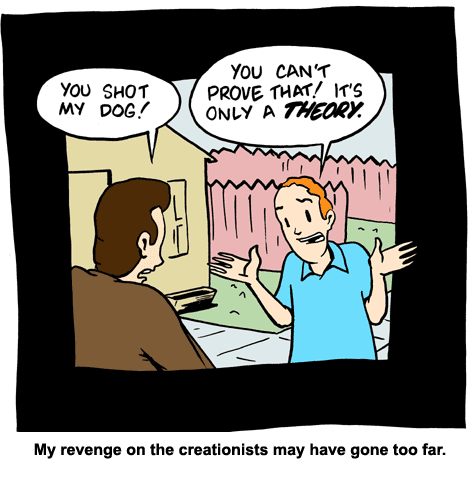
Tuesday Morning Comics #6


Here's another bit of irreverent humour from Saturday Morning Breakfast Cereal, poking fun at the Creationist misuse of 'theory'.  When biologists speak of evolution, they can speak of evolution as a 'fact', by which they are referring to things like experimental evolution in which change in a species is documented and not inferred, and they can speak of evolution as a 'theory', by which they mean that evolution is an explanatory framework which includes and explains, under a unifying whole, a disparate group of facts that had heretofore been considered separate.  Thus the Darwinian theory of evolution explains, among other things, the genetic similarities between all living things; adaptation; biogeography; palaeontology; morphological similarities; homologies; and a whole host of other things.  When Creationists say that evolution is 'just a theory', they mean something very different.  They quote the biologists who use the word theory, but they do not use it in the elevated sense of the biologist; instead they use it in its colloquial sense, as 'sheer speculation' or 'unproven'.  The above comic captures fairly well (and hilariously) the frustration that biologists feel over the consistent misuse of this important word.

Thursday, August 11, 2011

Even You Can Create a New Species - The Curious Case of Polyploidy

There are currently 1.7 million named species of plants, animals and algae on this planet.  This does not include the vast array of bacteria and other such single-celled creatures.  And those are only the ones we know about – based on rates of discovery, the National Science Foundation estimates that we have only described 10% of the world’s true diversity.  Most of these organisms will likely be small or marine, but not all; twenty-five species of primates have been discovered since 2000 alone.  And then this diversity really only scrapes the surface of the total diversity that has ever existed, with a mind-boggling number of plant and animal species known only from the fossil record.

Theodosius Dobzhansky, in Genetics and the Origin of Species (1937), presents, in chapters 7-9, an introductory treatment on the topic of speciation.  He brings genetics and natural selection and various observations together to provide a compelling account of how new species are formed.  This would be the groundwork used by Enrst Mayr, who would develop the modern Biological Species Concept.

Tuesday, August 09, 2011

Communion and a Call for Social Justice


I have, for most of my life, gone to a church that practices weekly Communion (what you may also know as the Lord’s Supper, or Eucharist, depending on your background).  Unlike Catholic traditions, my evangelical church would pass out tiny little cups containing grape juice, and would have tiny little portions of unleavened bread.  We would, as a body, take these little tokens/symbols (for us, not Sacraments) and ‘partake’ of them.  That was always the phrase.  ‘Partake’.  It was never ‘eat’ or ‘digest’ or, heaven forbid, ‘masticate’.  We were much more respectful than that.

Saturday, August 06, 2011

Natural Selection

We continue with our (seemingly unending) walkthrough of Dobzhansky’s evolutionary classic, Genetics and the Origin of Species.  Today we will finish his chapter on Selection; the rest of the book will be a cakewalk in comparison.

Natural selection was not unique to Darwin, having been recorded by numerous others, including the watchmaker-hypothesis’ William Paley.  But for these pre-Darwinian writers (with two minor exceptions, noted in the opening of the sixth edition of the Origin of Species), natural selection was simply a way of preserving the created species.  Forces would try to alter the species into less-adapted products; natural selection would winnow out those mutant forms, allowing the species to remain relatively pure.  Selection, then, was like a hangsman, killing off what nature abhorred.  Darwin’s major insight was to raise the status of natural selection from preserver and destroyer to the primary creative force in nature.  (I am indebted to Stephen Jay Gould’s book The Structure of Evolutionary Theory for much of this discussion).

Tuesday, August 02, 2011

Tuesday Morning Comics #5


Today's comic was clearly inspired by the teaching of Creationism in the school system.  Unfortunately, it is more insulting than inspired.  The school board in question is represented by a large-bodied cartoonish imbecile who is apparently not as 'evolved' as modern humans.  This comic would lead you to believe that the school board has less intelligence than a Neanderthal!  I am somewhat torn by this comic - I understand why people would find it funny, but this sort of name-calling is less than helpful, and is a real mischaracterization of the people who make up the Creationist movement.  Contrary to the public perception, Creationists are not idiots.  Philip Johnson, for example, is a leading Creationist and Intelligent Design proponent, yet teaches law at the University of California - Berkeley.  Last I checked, UCB does not hire slobbering morons.  The people that I have met who are strong Creationists may be stubborn to the point of annoyance, but they are intelligent people with, often, intelligent critiques.  It is just that their body of knowledge tends to be in a different direction than the body of knowledge that evolutionists have.  

Friday, July 29, 2011

Natural Selection and Population Growth

christmas island crabs
The yearly population explosion of crabs on Christmas Island was possibly due to the extinction of a native predator; the recent introduction of the yellow crazy ant has started bringing this population back down

By this point in our walkthrough of Dobzhansky’s biological classic, Genetics and the Origin of Species, we have seen how much raw phenotypic variation exists in the wild, and how this variation is generated by several different mechanisms, including mutations.  And we have discovered that some of this phenotypic variation, namely, genetic variation, is passed from parents to offspring.  Without heritable genetic variation, there can be no evolution.  But what drives evolution?  As we saw last week, evolution can be driven by mutation pressures and genetic drift.  But usually when we think of evolution, we are thinking of evolution by natural selection.  Dobzhansky devotes chapter six to this important topic. 

Tuesday, July 19, 2011

Tuesday Morning Comics #4


Today's comic is classic, in the sense that several other comics feature a similar joke.  Here we have a teacher holding up the Bible and instructing the children to get out their 'schoolbook' Bibles to learn about the subject of Intelligent Design (ID).  Clearly, this is a critique about Intelligent Design being taught in the classroom, which was a big topic when the Dover Area schoolboard tried to read a statement about ID to their class a few years ago.  Their argument was that ID presented a non-religious alternative to evolution.  Indeed, the proponents of ID are adamant that ID is not the same thing as Creationism, that it disregards religious arguments, and that it focuses on the scientific evidence for design.  They argue that, once one has seen the evidence for design, they are free in their religious beliefs to attribute that design to their deity, but that step is not a necessary part of ID.

Monday, July 18, 2011

Evolution is Math is Fun!

Evolution is ultimately mathematical.  This is in part why I have taken so long to continue with Dobzhansky’s book, Genetics and the Origin of Species – we are now getting to the math.  But the math cannot be ignored – in the early 1900s, some brilliant mathematicians developed formulae that predicted what biologists would spend the next seventy-plus years confirming experimentally.  Darwinian evolution is a case in which number (largely) preceded biology.

Tuesday, July 12, 2011

Tuesday Morning Comics #3


Morning folks.  Here is one of my favourite comics.  From its unintentional racism, to its false dichotomy (evolution instead of Jesus, as if one precludes the other), this comic is firing on all cylinders.  It was penned by Jack Chick of the infamous Chick Publications, who has been creating hate-filled ultra-fundamentalist tracts since the 1960s.  This particular one is copyright 2004.  You can buy these tracts on their website for 16 cents a piece, if you want to make an interesting collection.  Chick has been widely criticized by Catholics and Protestants alike, but his 200+ different tracts have been published in 100 languages and have been widely disseminated.  I think this comic will speak for itself about Chick's extreme fundamentalist beliefs, and how he views evolutionists (hint: they are very angry and argumentative).  Look for a shout-out to Dr. Kent Hovind, the Young Earth Creationist I saw speak when I was only a lad, and who is now serving serious jail time for tax evasion.  What is so sad to me is the mixture of real Christian beliefs with outright lunacy; the one taints the other.  It certainly shows why Rob Bell felt the need to write Love Wins.

Best line: '[Evolution] was created by the devil to keep kids out of heaven.'

Monday, July 11, 2011

A Response from the Minister of Fisheries!

A few months ago I wrote a letter to the Minister of Fisheries addressing a few key issues concerning Canada's oceans, as part of the social action section for a course my friend was teaching on social justice.  The issues addressed included the implementation of the Precautionary Approach for protecting Canadian fish stocks; the appalling lack of information given to consumers about the fish they consume; the lack of regulation in marine protected areas, and the paucity of such areas; and the insanity of determining an stock's endangered status based on socioeconomic considerations.  Considering that it was election time, I did not really expect a response, and so I was delighted to find a three-page letter from Senior Assistant Deputy Minister David Balfour of Ecosystems and Fisheries Management waiting for me in my mail when I returned from my trip out east.

It was a surprisingly candid and lengthy response to each of the issues I brought up.  Since we are talking about the Canadian government, there is much emphasis on what has been done and little about the criticisms.  But at least I now know that they know that there is at least one concerned Canadian out there.  For me, the most surprising admission in the letter is towards the end, in reference to the classification of endangered species in Canada.  It is somewhat shocking - see if you can spot it!

Wednesday, July 06, 2011

Tuesday Morning Comics #2


Today's comic is from the Young Earth organization Answers in Genesis.  This comic shows that Young Earth Creationists have a real concern for how Christians in general treat scripture.  Those that believe in an old earth and/or the theory of evolution do not turn to Genesis to find out how God created the word; they treat Genesis in a non-literal manner, whether as allegory or myth or poetry.  YEC are unsettled by this.  Genesis, to them, is the 'book of beginnings', a recorded history of the beginning of God's covenant with His people and the beginning of the world itself.  And this account of beginnings is a literal historical narrative.  Those outside of the Christian faith may find this comic illuminating because it reveals a divide in Christianity between those who treat Genesis' opening chapters 'literally' (although even the literalists tend to allegoricalize when convenient) versus those who do not.  Christianity is not a monolithic religion with each Christian believing the same thing.  There is an incredible amount of diversity, a diversity which Answers in Genesis finds disturbing.

This comic also questions what Christians take to be authoritative.  Is the only authority the Book of God's Word, or can we also turn to the Book of God's Works?  Is creation as authoritative as scripture?  Can a Christian, in good conscience, turn to the books of science to understand beginnings rather than the 'book of beginnings'?  For YEC, the answer is clearly no; for other Christians, the answer is not so clear.

Yes, I realize today is actually Wednesday, but I've been at camp in PEI all week with a bunch of grade 2 and 3 students, and I did not come to this realization until just now.  Deal with it.

Tuesday, June 28, 2011

Tuesday Morning Comics

Hi all!  I've been spending a lot of time on here writing about science instead of science and religion (although I would argue that to discuss science and religion, religious people need to understand science, and scientists need to understand religion, which is what motivates these posts), so as I prepare to leave Quebec I wanted to share a science/religion comic with you.  I find these things all over the internet, and I am amassing a collection of them.  I'll post one from time to time.  

Sunday, June 26, 2011

Variation

Humans come in different shapes, sizes, colours, temperaments, propensities to disease and the like.  Although the human population continues to increase, we seem to never run out of variations on the human ‘type’.  All of the dog breeds of the world ultimately descend from the same wolf ancestor.  The bulldog, the terrier, the great Dane, the German shepherd, were all produced when humans took existing varieties and made some choice selections.  The same goes for our agricultural products: kale, cabbage, broccoli and cauliflower all descend from the same wild cabbage species.  The fruit fly Drosophila pseudoobscura, according to Dobzhansky, has seven different types of Y chromosomes; there are strains of wheat with 7, 14 or 21 chromosomes.

Without variation, there can be no evolution.  Dobzhansky spends the first four chapters of his book driving this point home, because it is that essential.  If variation was not continually being produced, there would be no differences between individuals; without differences between individuals, there would be no selection; and without selection, there would be no adaptation.

Thursday, June 23, 2011

The Joy of Chromosomes (Part 3)

Last week we talked a bit about chromosomes, the process of sperm/egg/pollen formation, and how missteps during meiosis can lead to chromosomal mutations in terms of numbers of chromosomes.  We defined haploidy and polyploidy as the loss or gain of an entire set of chromosomes, and monosomy and polysomy as the loss or gain of a single chromosome.   We also saw how species and races contain variability, not just in the content of their DNA, but also in the number of chromosomes that they have.  Humans, for instance, have one less chromosome than the other great apes; a single species of Iranian climbing weed has populations with vastly different numbers of chromosomes.

Today I’d like to continue following the layout of Dobzhansky’s book, Genetics and the Origin of Species, by continuing to categorize chromosomal mutations according to changes in their structure.  Structural mutations do not affect the number of chromosomes within an organism, but rather alter the layout of genes within a chromosome.  Structural mutations can be classified as follows:

Tuesday, June 21, 2011

Chromosomes, Chimps, and Human Evolution

I have been working hard in Quebec collecting my microarray data, and between that and a great visit from my dad over father's day, I simply have not had time to write the next article on chromosomes.  But in anticipation of the evolutionary importance of chromosomal mutations, here is a video clip from evolutionist and Catholic Kenneth Miller, discussing what I consider to be the single most powerful evidence for the evolution of humans from a primate ancestor, and it involves a chromosomal mutation.

The court case he refers to at the beginning is the trial that occurred in Dover, Pennsylvania, in 2004 over the religious nature of Intelligent Design.  Kenneth Miller testified against the school board, arguing that ID has no place in a science classroom.  The part of the lecture I am showing was part of a tour he gave after the court case, explaining exactly what he, as a religious man and a scientist, has serious issues with ID.

Enjoy.


Thursday, June 16, 2011

The Joy of Chromosomes (Part 2)

Chromosomes are the carriers of genes.  Each chromosome acts as an individual, faithfully passing its structure on to its offspring each time a cell divides.  But ‘faithfulness’ has its limits – occasionally a ‘mutant’ chromosome is produced that will then be replicated.  The number of chromosomes within a cell can also be faithfully replicated down the generations, but occasionally they too can change.

When we talk about chromosomal mutations, then, we need to differentiate between changes in chromosome number and structure.  Today, we will talk about number.

Tuesday, June 14, 2011

The Joy of Chromosomes (Part 1)

So, you have found yourself transported in time to the 1930s, and you have a strong desire to study mutations?  But those uncivilized brutes have yet to develop methods for examining changes in DNA?  Never fear!  You can do the second-best thing, and rediscover everyone’s favourite pastime: karyotyping!

Tuesday, June 07, 2011

All Species Are the Products of Mutations

Summary so far

To recap our story: evolutionary biology’s ultimate quest is to explain the diversity and discontinuity we see in the natural world.  A whale and a mouse are two very different things; they do not insensibly blend into one another.  Yet despite their discontinuity, they also have very similar body structures.  What accounts for this?  And why in less extreme cases is this discontinuity at times fuzzy, such that we have difficulty telling if two different populations are different species, or merely varieties of the same species?

Saturday, June 04, 2011

Mutations: The Good, the Bad, and the Neutral (Part 5)

Lesson 5: A single mutation cannot create a new species

There was some debate during Dobzhansky’s time about whether new species could be formed through the birth of rare ‘monsters’.  Such monsters would be the product of a mutation, and would be effectively shut off from the rest of the population, forming their own species.  This theory was called saltationism.  Saltationists argued that a single mutation can have a very large effect.  A mutation somehow produces fundamental changes to the species, such that a new species is formed.